Concrete vs Asphalt Driveway in Tennessee — Which Should You Choose?
Most Lawrence County and Giles County homeowners who call us have already been debating concrete versus asphalt for a while. Both work. Both are common in Middle Tennessee. But they're genuinely different products with different costs, maintenance requirements, and lifespans — and the right answer for your property depends on a few specific factors. We pour concrete, so we have a bias. We'll try to set that aside and give you a straight answer on when each one makes more sense.
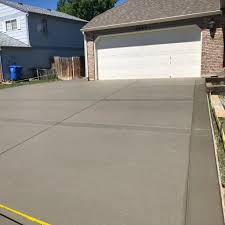
A freshly poured concrete driveway in Lawrenceburg — broom finish, properly jointed, and graded to move water toward the street.
Quick answer
For most Lawrenceburg and Pulaski homeowners planning to stay in their home long term, concrete is the better investment. It costs more upfront but lasts 30 to 50 years with minimal maintenance versus 15 to 20 years for asphalt. If you're on a tight budget, plan to sell soon, or have a very long rural approach where you're filling in sections over time, asphalt may make more financial sense. Tennessee's climate doesn't dramatically favor one over the other — both handle heat and occasional ice.
Upfront cost in Middle Tennessee
In Lawrence and Giles County, concrete driveways typically run $7 to $13 per square foot installed. Asphalt driveways in the same area run roughly $3 to $6 per square foot installed. On a 700 square foot two-car driveway, that's a gap of roughly $3,000 to $7,000 in favor of asphalt.
That gap matters more when you're working with a tighter budget or when the driveway is long — some rural Lawrence County properties have 200-foot approaches where the square footage adds up fast. On those jobs, asphalt's lower per-square-foot cost has real weight.
Concrete
- $7–$13 per sq ft installed
- 30–50 year lifespan
- Minimal maintenance
- Doesn't soften in summer heat
- Can be decorative (stamped, colored)
- Repairs are visible
Asphalt
- $3–$6 per sq ft installed
- 15–20 year lifespan
- Seal every 3–5 years required
- Softens slightly in peak summer heat
- Black only — no decorative options
- Repairs blend in better
Lifespan and maintenance — where concrete earns its premium
A concrete driveway installed correctly in Tennessee should last 35 to 50 years. The primary maintenance is optional: sealing every 3 to 5 years helps prevent staining and minor surface scaling, but unsealed concrete will still hold up structurally. Concrete doesn't require anything mandatory to reach its expected lifespan.
Asphalt needs to be sealed every 3 to 5 years to prevent oxidation and surface cracking. Skip sealing, and you'll see cracking and potholing significantly earlier. The cost of crack filling, seal coating, and eventual overlay or replacement adds up meaningfully over time. When you factor that in, the lifetime cost difference between concrete and asphalt narrows considerably.
How Tennessee's climate affects the comparison
Middle Tennessee sees hot, humid summers, occasional ice in winter, and significant rainfall year-round — averaging over 52 inches annually. Here's how that affects each material:
Summer heat: Asphalt softens slightly in sustained high temperatures, which can lead to surface rutting where vehicles sit still — particularly heavy vehicles in the same spot repeatedly. Concrete doesn't have this problem. In parts of Tennessee where summer temperatures regularly exceed 95°F, this is a real consideration near vehicle parking spots.
Winter ice: Neither material handles ice as well as people hope, but concrete is damaged more by rock salt than asphalt is. If you use rock salt heavily for ice management, avoid it on concrete — it accelerates surface scaling. Sand or calcium chloride are better options. Asphalt is slightly more tolerant of deicing salts.
Heavy rainfall: Both require proper drainage grading to perform well long-term. A driveway that pools water damages both materials faster — through freeze-thaw expansion in winter and soil erosion underneath in wet weather. This is really a site prep and installation issue, not a material one.
When asphalt makes more sense
We recommend asphalt in a few specific situations. If your budget is a hard constraint and the driveway is large — a 300-foot rural approach — asphalt lets you get it done without stretching. If you're planning to sell the property in the next few years, a new asphalt driveway improves curb appeal meaningfully at a lower investment. And for long gravel driveways that you're converting in phases, asphalt is more commonly done in sections over time because repairs blend invisibly.
When concrete makes more sense
For anyone planning to stay in their home long-term, concrete is the clearer choice. The near-zero maintenance requirement, the significantly longer lifespan, and the cleaner appearance all point toward concrete as the better lifetime value. If you want decorative options — stamped patterns, colored concrete, decorative borders — concrete is your only real choice. And for heavy vehicle use, concrete at the right thickness outperforms asphalt in durability.
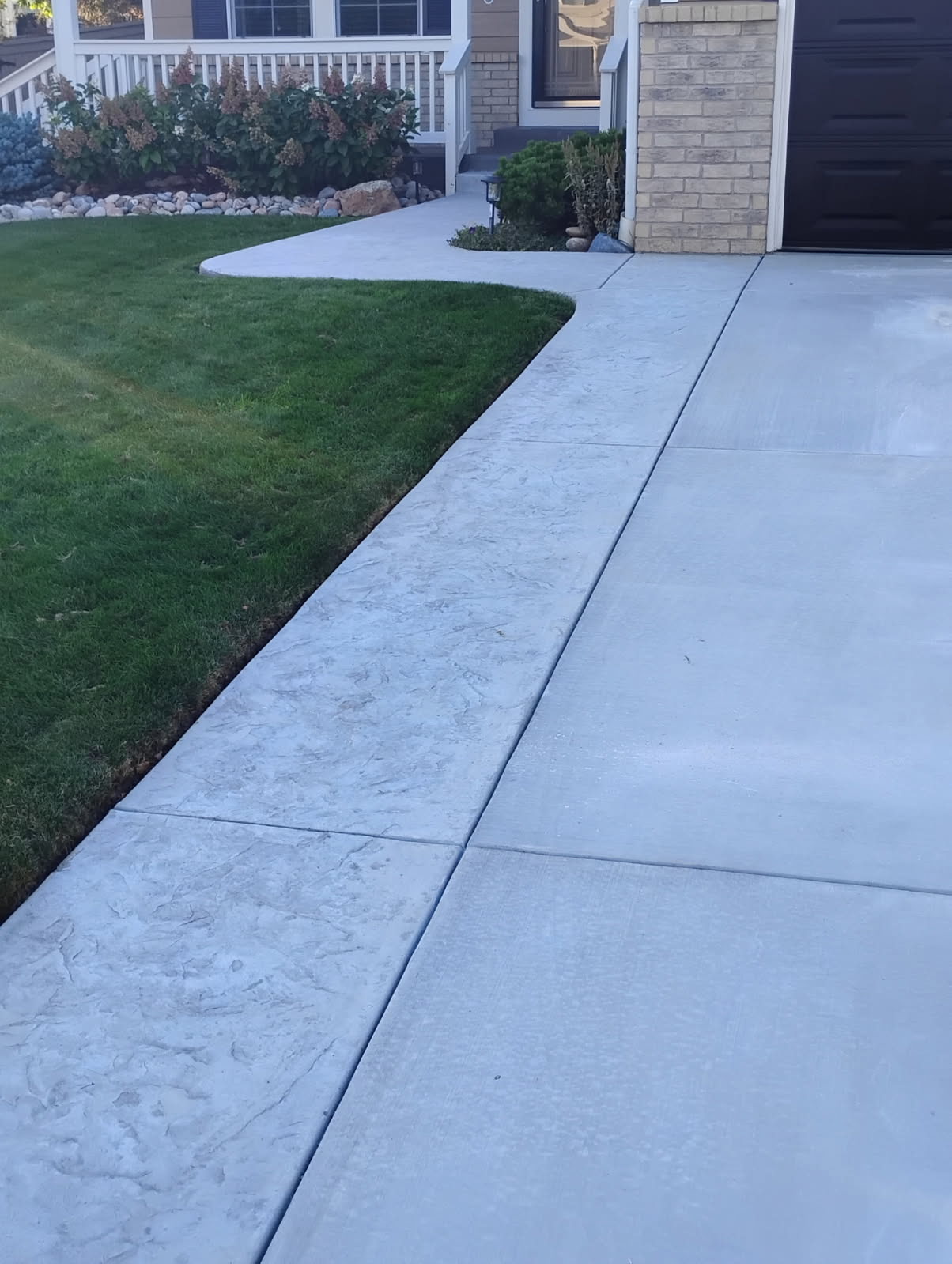
Concrete allows decorative options like textured borders and matching sidewalks that asphalt simply cannot replicate.
Frequently asked questions
Is a concrete driveway cheaper than asphalt in the long run?
Usually yes, when you account for the full picture. Asphalt costs less upfront but requires seal coating every 3 to 5 years and will need replacement in 15 to 20 years. A concrete driveway installed in 2025 may still be serviceable in 2065 with minimal maintenance. On a 30-year horizon, the total cost per year often favors concrete despite the higher upfront price.
What lasts longer, concrete or asphalt, in Tennessee specifically?
Concrete. A well-installed concrete driveway in Lawrence County or Giles County will last 35 to 50 years. Asphalt in the same market typically runs 15 to 25 years before needing major work or replacement. Tennessee's climate — particularly its rainfall and summer heat — isn't dramatically harder on one material than the other.
Can I add a concrete driveway over my existing asphalt?
Not recommended, and in most cases we won't do it. Pouring concrete over existing asphalt creates a bond problem — the two materials don't adhere, and the concrete can separate and crack unpredictably. The standard approach is to remove the asphalt, evaluate the subgrade, prepare the base properly, and pour fresh concrete. Demo and haul-off of existing asphalt adds $1.50 to $2.50 per square foot to the project cost but gives you a proper, long-lasting result.
Does a concrete driveway add home value?
Generally yes, more so than asphalt. Concrete driveways are perceived as a premium feature and tend to appraise better. The curb appeal improvement from replacing a worn asphalt or gravel driveway with concrete is meaningful and often commented on by buyers and agents. Exact value impact depends on your market, neighborhood, and the quality of the installation.
If you're ready to get a concrete driveway quote for your property in Lawrenceburg, Pulaski, or anywhere in Middle Tennessee, call us at (931) 369-2134 or request a free estimate online. See our concrete driveway service page and our Lawrenceburg concrete page for more detail on what we offer in your area.